How to make a invoice in one minute
- Three dated sample lines are prefilled. Replace each Description with the date and task, type the hours in Qty (3.25 is fine) and set your Rate. Press Duplicate on a line to copy it, rate included.
- Fill in From with your business and Bill to with the client. Type the billing period, for example 22–26 September, in Reference / PO number.
- Check Invoice number and Date, then choose Net 14 under Terms so the Due date matches the prefilled terms.
- Under Totals, add a Tax line if you charge one, and enter anything already paid in Amount paid.
- Keep or edit the Notes about 15-minute increments, add Payment details and press Download PDF.
How to invoice for hourly work
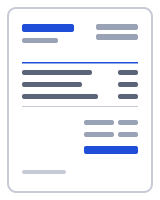
The sample invoice covers three days of work for one client at 85 per hour: 2.5 hours on Monday 22 September for an onboarding call and setup, 6 hours on Tuesday for data migration, and 3.25 hours on Thursday for testing and handover. Each line carries the date and the task in its description, the hours in the Qty column and hrs as the unit, and the Amount is calculated. That layout is the whole method: one line per day or task, so the client can check every entry against their own notes.
Decide on an increment and state it. Six, ten and fifteen minutes are all common; fifteen is the default in the prefilled Notes (“Hours are recorded in 15-minute increments”). The Qty field accepts up to four decimals, so 3.25 hours, 0.5 days or 1.1667 hours all work. Keep one rate per line. If Tuesday mixed a standard rate and an overtime rate, use two lines for Tuesday rather than an averaged figure.
The billing period belongs in Reference / PO number, for example 22–26 September, so the invoice states which week or month it covers even before the reader gets to the lines. The prefilled terms ask for payment within 14 days of the invoice date; choose Net 14 under Terms and the Due date follows.
Adding a day is quick. Press Duplicate on the last line and the rate comes with it; change the date, task and hours. Press Enter on the last Rate field to add an empty line instead. When a client asks for a timesheet, the notes already say one is available on request, so keep your own record of start and end times and send it as a separate attachment.
What the hourly invoice template prefills
Three dated lines at one rate, hrs as the unit, notes about 15-minute increments and terms of 14 days. Your details, the client, the billing period and any tax line are yours to add. Replace the dates and tasks rather than deleting the lines, so each description keeps the day-and-task pattern the client can reconcile.
Your data stays on your device
Your hours, rates and client details stay in this browser; nothing you type is sent to a server. The PDF is generated in your browser by a small worker; nothing is uploaded, and there is no account to create. Drafts, clients and your business profile live in your browser's local storage (IndexedDB), and one button under "Your data" deletes all of it. To verify, open your browser's developer tools, watch the Network tab while you fill in and download a document, and note that no request carries your details. Read the privacy policy and how it works for the details.
Templates, currencies and PDF output
| Templates | Classic, Modern, Minimal, Compact, Ledger, Receipt (6 layouts; accent colour and logo are yours). Prefilled invoice and receipt templates by trade open in the same editor. |
|---|---|
| Currencies | 68 ISO currencies with the right symbol and decimals, for example USD, CAD, GBP, EUR, AUD, INR and JPY. Country presets also set the tax lines and ID labels. |
| Paper sizes | A4 and US Letter; page numbers on multi-page documents |
| Numbering | Sequential per type, default prefix INV-0001, editable |
| Output | PDF download (text stays selectable), print, or a prefilled email with the PDF attached by you; file name Invoice-number-client.pdf |
Frequently asked questions
Should I bill hours in 6, 10 or 15-minute increments?
Any of the three works as long as you say which on the invoice and use it consistently. Fifteen minutes is the most common and appears in the prefilled Notes. In the editor, 15 minutes is 0.25, six minutes is 0.1 and ten minutes is 0.1667; the Qty field accepts up to four decimals.
Should each day be its own line?
Yes, or each task if a day covers unrelated work. The sample uses one line per day with the date and task in the description, so the client can match it to their own records. Put the whole billing period in Reference / PO number and the invoice reads like a summary of your timesheet.
How do I bill overtime or a second rate?
Keep one rate per line. When a day mixed standard and overtime hours, add a second line for the same date with the overtime hours and the higher rate, and say why in the description. The client sees both rates and the totals add up without a footnote.
Do I need to attach a timesheet?
Not usually, if the descriptions carry the dates and tasks. The prefilled Notes say a timesheet is available on request, which is enough for most clients. If a client asks for one every time, keep the invoice lines as they are and send the timesheet as a second attachment.
Hourly or fixed price for this kind of work?
Hourly suits work where the scope is not fixed in advance, such as migration, support or troubleshooting. A fixed price suits a defined deliverable. If you mix them for one client, put the fixed item on its own line with a unit such as each, and keep the hourly lines in hrs.
Can I reuse the invoice every week or month?
Yes. Save as template stores the client, rate and layout for New from template next time. For a repeat period, open last month's invoice in Recent documents and press Duplicate: you get the next number and today's date, and you only change the dates and hours on each line.
Related
- Free invoice generator
- Freelance invoice template for project, per-piece and hourly work
- Consulting invoice template for day rates, retainers and expenses
- Handyman invoice template for hourly jobs and materials at cost
- Tutoring invoice template with session dates and a student field
- Invoice generator USA: invoices with sales tax, in US dollars
Last updated 2026-09-27. Presets are starting points — confirm current rates and requirements with your tax authority. PDF engine: pdfmake (MIT); fonts: Inter and Noto Sans (SIL Open Font License).