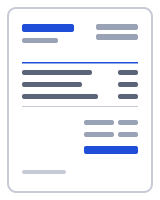
How to make a invoice in one minute
- Choose New Zealand under Country preset. Currency switches to NZD, Paper size to A4, dates to DD/MM/YYYY, a GST line at 15% appears under Totals and the heading reads Tax Invoice.
- Fill in From with your name or trading name, address and GST No. Leave the number blank and remove the GST line if you are not registered.
- Fill in Bill to with the customer's name and address, and their GST No. if they are a registered business. Check the Invoice number, Date and Due date.
- List your Line items with a Description, Qty, Unit and Rate. Untick GST on any zero-rated line so the GST amount under Totals is right.
- Add your bank account number under Payment details, keep or edit the Notes, then press Download PDF.
What an invoice in New Zealand must show
Inland Revenue describes what a tax invoice needs to show, and the editor’s checklist for the New Zealand preset follows it. If you are registered for GST, the document should say Tax Invoice, so the preset prints that heading whenever the GST line has a rate above zero. Remove the line and the heading reads Invoice, which suits a sole trader who is not registered.
Your name or trading name and your GST number go in the From block, where the label reads GST No. Then the invoice date, printed DD/MM/YYYY, and a unique number that the counter increments for you. The customer’s name and address go in Bill to, with a GST No. field for business customers who will claim the GST back.
Each line item needs a description of the goods or services and the quantity, which the Description, Qty, Unit and Rate columns provide, and the amount is calculated. Under Totals, the GST amount is shown on its own line at 15%, or, with the tax-inclusive toggle on, the invoice states that GST is included in the total and shows how much. Either way the customer can see the GST component.
The currency defaults to New Zealand dollars and the paper to A4, both changeable under Document settings. The notes template reads “Payment by the due date is appreciated. Bank account details are below.” and you can edit it. Presets are starting points — confirm current rates and requirements with your tax authority. New Zealand’s rules now speak of taxable supply information rather than tax invoices, and the amount of detail required depends on the value of the sale; the Tax Invoice heading is still widely used, the checklist covers the fuller set of details, and rates here are defaults as of 2026-09-27.
Invoice generator NZ: GST at 15% and the Tax Invoice heading in the editor
New Zealand has one GST rate, so the preset loads a single line at 15% and the question on each invoice is whether it applies. With the line in place and every item ticked, the heading reads Tax Invoice and the GST amount sits under Totals. Untick GST on a line for a zero-rated supply, such as an export, and that line is left out of the GST calculation while the rest stays taxable. Delete the line and the heading drops back to Invoice.
Prices in New Zealand are often quoted GST inclusive. Turn on the tax-inclusive toggle and the editor works backwards from your figures: a $115.00 price prints as $100.00 plus $15.00 GST and the total stays $115.00. Registered customers still get the GST figure they need.
The second and third tax lines and the compound flag are available for other countries and are not needed here. Payment details print your bank name and account number, and a Pay online link if you use one; New Zealand account numbers are long, so the account field accepts the full bank, branch, account and suffix string.
Your data stays on your device
Your New Zealand tax invoices, GST number and customer details are created and stored on this device only, never on a server. The PDF is generated in your browser by a small worker; nothing is uploaded, and there is no account to create. Drafts, clients and your business profile live in your browser's local storage (IndexedDB), and one button under "Your data" deletes all of it. To verify, open your browser's developer tools, watch the Network tab while you fill in and download a document, and note that no request carries your details. Read the privacy policy and how it works for the details.
Templates, currencies and PDF output
| Templates | Classic, Modern, Minimal, Compact, Ledger, Receipt (6 layouts; accent colour and logo are yours). Prefilled invoice and receipt templates by trade open in the same editor. |
|---|---|
| Currencies | 68 ISO currencies with the right symbol and decimals, for example USD, CAD, GBP, EUR, AUD, INR and JPY; the New Zealand preset picks the default. Country presets also set the tax lines and ID labels. |
| Paper sizes | A4 and US Letter; page numbers on multi-page documents |
| Numbering | Sequential per type, default prefix INV-0001, editable |
| Output | PDF download (text stays selectable), print, or a prefilled email with the PDF attached by you; file name Invoice-number-client.pdf |
Frequently asked questions
Do I need a GST number to send an invoice in New Zealand?
No. Only businesses registered for GST have a GST number, and only they should print one or add GST. If you are registered, put the number in the GST No. field on the From block so customers can claim the GST back. If not, leave it empty and delete the GST line so the invoice does not show a tax you are not collecting.
What if I am not GST registered?
Delete the GST line under Totals. The heading changes from Tax Invoice to Invoice and the totals show a subtotal and total only. Many sole traders below the registration threshold invoice this way. Whether you have to register depends on your turnover, so check Inland Revenue's current threshold rather than a preset.
Invoice or tax invoice: which heading should I use?
Use Tax Invoice when you are GST registered and charging GST, and Invoice when you are not. The preset decides for you: the heading reads Tax Invoice whenever the GST line has a rate above zero and Invoice otherwise. Document title is editable text, so you can change the heading by hand if your customer asks for different wording.
How do I show GST-inclusive prices?
Turn on the tax-inclusive toggle for the GST line. The editor works backwards from the prices you typed: $115.00 becomes $100.00 plus $15.00 GST and the total stays at $115.00. The invoice states that GST is included in the total and shows the amount, which is what a registered customer needs for their return.
Which paper size and date format does the preset use?
A4 and DD/MM/YYYY, matching New Zealand offices and printers. Both are defaults under Document settings: switch to Letter if you invoice clients in North America, or pick another date format, and the preview updates at once. The currency is NZD with two decimals; the symbol and code can be changed with the Currency setting.
Can I invoice an Australian or overseas client in their currency?
Yes. Change Currency under Document settings to AUD, USD or any other currency and every amount, including the GST line, uses its symbol and decimals. Exports are often zero-rated: untick GST on those lines or delete the GST line, and the heading returns to Invoice. Check with Inland Revenue or your accountant before treating a sale as zero-rated.
How long should I keep my invoices?
Inland Revenue generally expects business records, including the invoices you issue, to be kept for seven years; check its current guidance for your situation. The invoices you make here stay in this browser, so save a JSON backup through Export data and keep each downloaded PDF with your accounts.
Related
- Free invoice generator
- Invoice generator Australia: tax invoices with ABN and GST
- Invoice generator UK: VAT invoices at 20%, 5% or 0%
- Invoice generator for Singapore (9% GST, tax invoice)
- Hourly invoice template with a line per day and 15-minute increments
- Freelance invoice template for project, per-piece and hourly work
- Electrician invoice template with site address and licence number
- Blank invoice template to print and fill in by hand
Last updated 2026-09-27. Presets are starting points — confirm current rates and requirements with your tax authority. PDF engine: pdfmake (MIT); fonts: Inter and Noto Sans (SIL Open Font License).